A practical guide to how surgeons in Turkey help patients choose the right implant size, type and placement for breast augmentation.
21.09.2026
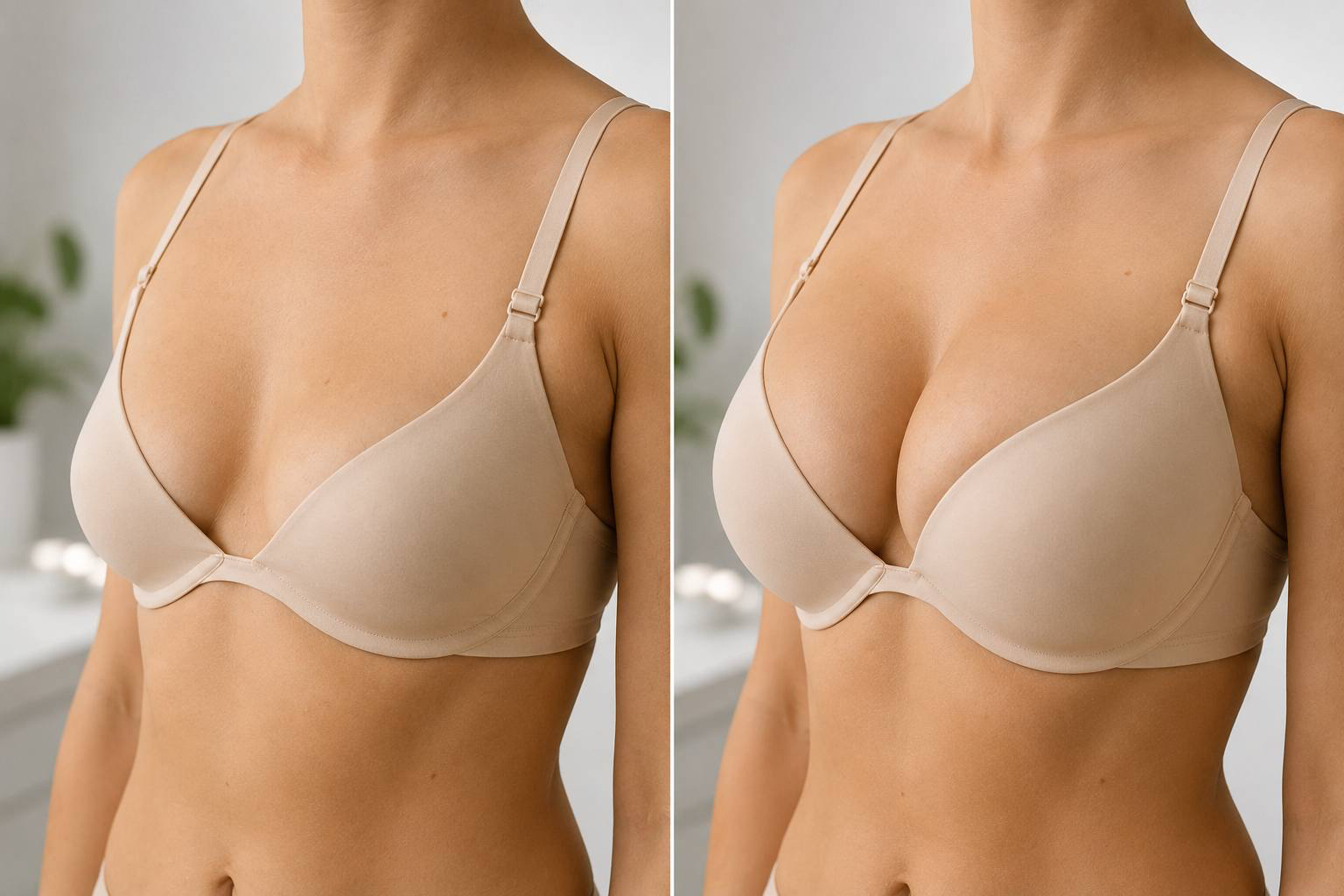
Breast augmentation in Turkey starts with a physical consultation, not a photo you bring in. Surgeons measure chest width, existing breast tissue, skin elasticity and shoulder width, then use those numbers — alongside the look you want — to narrow down implant volume, shape and placement. Understanding how each of those decisions gets made helps you arrive at your consultation prepared, and makes the final result far more predictable.
Almost all breast augmentations performed in Turkey today use cohesive silicone gel implants rather than saline. Silicone gel holds its shape and feels closer to natural tissue, and modern "gummy bear" cohesive gel implants keep their form even if the shell is damaged. Saline implants are rarely offered because the aesthetic result is less natural and the profile options are more limited.
Implant volume is measured in cubic centimetres (cc), not cup sizes, because cup size varies between manufacturers and countries. During the consultation, many surgeons use sizers — trial implants worn inside a bra — so you can see and feel the difference between, for example, 300cc and 375cc on your own body. Your existing tissue, chest width and skin quality set the practical upper limit; going larger than your frame supports increases the risk of sagging and visible rippling over time.
Round implants give more fullness in the upper part of the breast and a more noticeable "lift" effect even without a separate lift procedure. Anatomical (teardrop-shaped) implants taper toward the top and are chosen when a more gradual, natural slope is the goal. Profile — how far the implant projects forward for a given width — is matched to your chest width so the implant does not look wider than your body.
Implants can sit above the chest muscle (subglandular), below it (submuscular), or in a dual-plane position that combines both. Submuscular and dual-plane placement is more common in Turkey for patients with thinner natural tissue, because the muscle provides extra coverage and a softer transition at the upper edge of the implant. Subglandular placement is sometimes preferred for patients with more natural tissue already, or when a faster recovery is a priority, since it involves less disruption to the muscle.
The inframammary fold (the crease under the breast) is the most common incision site in Turkey, because it gives the surgeon direct access and the resulting scar is hidden in the natural crease. Periareolar (around the nipple) incisions are used less often and mainly when a lift is combined with the augmentation. Your surgeon will discuss which approach suits your anatomy and the implant size chosen.
If there is noticeable sagging (ptosis) before surgery, an implant alone will not correct it — the tissue needs to be repositioned as well. Surgeons assess nipple position relative to the breast crease to decide whether a lift is needed alongside the augmentation. Combining both procedures in one operation is routine in Turkey and does not usually add extra recovery time beyond a standard augmentation.
Can I choose my exact implant size before I arrive?
You can share reference photos and a rough size range in advance, but the final cc size is confirmed at the in-person consultation once your surgeon has measured your chest and tissue.
Will the implants look and feel natural?
Modern cohesive silicone implants, correctly sized for your frame and placed appropriately, move and feel close to natural breast tissue. Oversized implants relative to your chest width are the main cause of an unnatural look.
How long before the implants settle into their final position?
Implants typically "drop and fluff" into their final shape over 6 to 12 weeks; full softening of the tissue can take up to a few months, which our breast augmentation recovery timeline covers in more detail.
This page is general information, not medical advice. Suitability, technique and results are determined individually by a licensed surgeon.
Send us what you already have — the pathology report, imaging on disc, discharge summaries. A specialist at a partner hospital will review it and tell you what is realistic in your case and how quickly treatment could begin. Reviewing your documents costs nothing and commits you to nothing.
Send your documents
Refused laser eye surgery? The six medical reasons a surgeon says no — thin cornea, high prescription, keratoconus, age — and the alternative for each.
Lazy eye laser eye surgery rarely restores lost acuity: what amblyopia means for LASIK, SMILE and ICL in Turkey, and when correction is still worth it.
ICL is an implantable lens for people refused laser correction because of thin corneas or a high prescription — how it works, what the examination has to confirm, and what it costs in Turkey from €4,700 for both eyes.