DHI opens the channel and places the follicle in one movement; FUE separates the two steps. Which suits you depends on your donor area, not on price.
10.09.2026
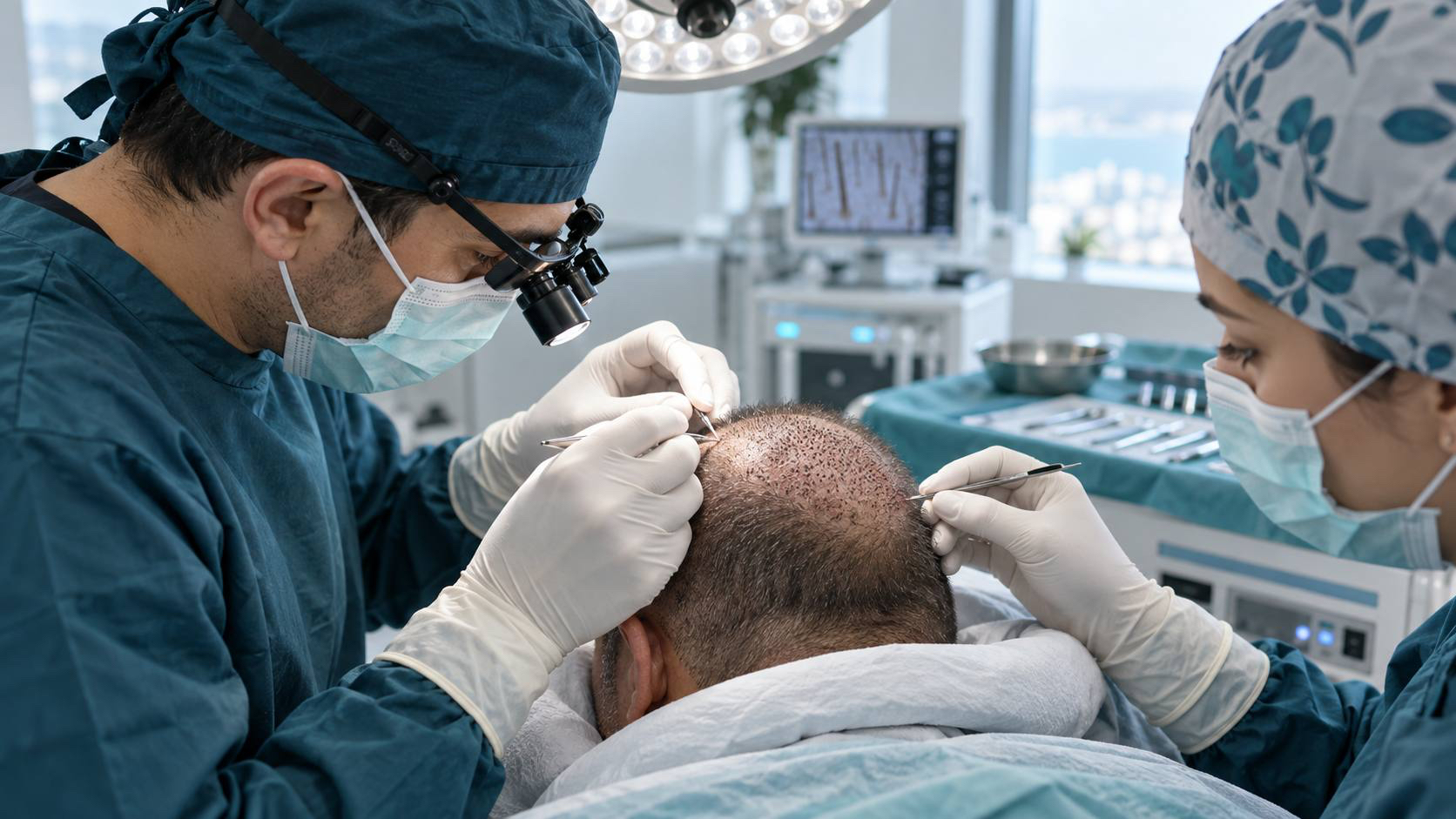
The difference between FUE and DHI comes down to one step of the operation: whether the channel that receives each follicle is opened in advance or created at the moment the follicle is placed. Everything else the two acronyms are used to sell — density, naturalness, permanence — is decided by your donor area, the surgical plan and the person holding the instrument. This article explains what each technique physically does, where the difference genuinely changes the result, and how to avoid paying more for a method that does not suit the area you need covered.
FUE stands for follicular unit extraction. A punch less than a millimetre across removes follicular units one at a time from the donor area at the back and sides of the scalp, where hair is genetically resistant to thinning. Each unit contains one to four hairs, which is why a graft count and a hair count are never the same number.
Placement then happens in two separate stages. The surgeon first opens recipient channels across the thinning area — small incisions made at a chosen depth, angle and direction. The grafts are then placed into those prepared channels, in most high-volume clinics by trained technicians working with fine forceps.
The channel-opening stage is where the result is designed. The angle of each incision fixes the direction the hair will grow. The spacing fixes density and decides how the transplanted zone blends into the hair already there. A technically flawless extraction cannot rescue channels opened at the wrong angle.
DHI, direct hair implantation, extracts follicles in exactly the same way. The difference is what happens next. Each graft is loaded into a Choi implanter — a pen with a fine hollow needle. The needle pierces the scalp and a plunger pushes the follicle into the opening in a single movement, so the channel and the placement happen together and no channel exists before the graft arrives.
Two things follow. Angle, depth and direction are controlled at the moment of implantation rather than at an earlier stage, and grafts can be threaded between existing hairs without the recipient area being clipped. That is why DHI is the method clinics use for unshaven and partially shaven cases, and why it is often chosen for adding density among hair that is thinning but still present.
| Dimension | FUE | DHI |
|---|---|---|
| Channel opening | A separate stage, completed before any graft is placed | The same movement as placement, through the implanter pen |
| Density achievable | High; the ceiling is donor supply and scalp blood supply, not the tool | Comparable, with an advantage when placing hairs between existing ones |
| Shaving | Donor area shaved, recipient area usually shaved too | Recipient area can stay unshaven; the donor area still needs a clipped zone |
| Speed | Faster placement; large graft numbers fit into one day | Slower; grafts are loaded and placed one at a time |
| Large areas | The workhorse for 4,000 grafts and above | May require two days or a reduced graft number |
| Typical pricing | The clinic's baseline technique | Usually quoted above FUE at the same clinic |
| Best suited to | Extensive coverage and whole-scalp restoration | Hairline detail, density among existing hair, unshaven cases |
DHI is slower. Grafts are loaded into the implanter and placed one by one, and a team gets through fewer grafts per hour than during a conventional placement stage. For a receding hairline of 2,000 to 2,500 grafts this rarely matters. For a full restoration of 4,000 grafts or more it matters a great deal.
Slower placement leaves a clinic three options, and you should know which one you are being offered before you pay a deposit:
None of those is dishonest in itself. Being told about it only after you have arrived is. And it is worth saying plainly that no technique creates hair. Both methods move a finite number of follicles from the back of your head to the front. If the donor area cannot supply what the recipient area needs, changing the acronym does not change the arithmetic.
In busy clinics the surgeon typically performs the consultation, the hairline design and the channel opening, while trained technicians carry out extraction and placement. That division of labour is standard in this field and is not by itself a problem — a team that does this every day is often more consistent than an occasional operator. What matters is that the division is stated openly.
With DHI the question sharpens, because the implanter pen both cuts the channel and places the follicle. Whoever holds the pen is deciding the angle, depth and direction of every hair as it goes in. Ask before you book:
A clinic that answers these calmly is telling you more about your likely result than any technique name. The same questions are the core of what actually decides a good hair transplant result.
The honest way to choose is to start from two fixed quantities: how much hair your donor area can spare, and how much surface has to be covered. Typical graft requirements give a sense of scale:
At the lower end, either technique works and the choice can reasonably follow whether you want to avoid shaving. At the upper end, FUE remains the practical answer for a single-session operation, and a clinic pushing DHI for 4,000-plus grafts should be asked directly how many days that will take and what it will cost. On our hair transplant service page the technique is proposed after the assessment of your photographs, not before.
Where DHI costs more, it is buying chair time, single-use Choi tips and more staff hours per graft — not a different biological outcome. That distinction gets lost when the two techniques are sold as good and better.
Market context helps. In the United States FUE runs at roughly $4–$10 per graft, and most patients pay $6,000–$12,000 for a session. In the United Kingdom the average is around £3.25 per graft, which is roughly £6,500 at 2,000 grafts and £13,000 at 4,000; in one analysis of quotes given to the same patient the lowest was £1,995 and the highest £15,000, which tells you how loosely these prices are set. MedAgent partner clinics work from an all-inclusive FUE or DHI package from €2,000, with the final figure quoted after a free assessment of your photographs. The full breakdown is in our cost comparison for Turkey, the UK and the USA.
One practical warning: a flat price for an unlimited number of grafts is not generosity. Pin the graft number down as a number in the quotation, whichever technique is used.
Some patients should not have a transplant this year, and a surgeon who says so is protecting your donor area rather than losing a sale.
The clearest case is a young man losing hair rapidly. A transplant redistributes hair; it does not cure androgenetic alopecia. The native hair around and behind the transplanted zone carries on thinning unless it is treated medically, so a hairline built at twenty-four can end up as an island in front of a receded crown by thirty — and the grafts spent on it are gone from a donor area that never regenerates. In that situation the sequence is medical treatment first, a stable pattern next, surgery after that.
Other cases where the answer is wait or no: a donor area too thin to supply the area to be covered, whatever the technique; hair loss that is not androgenetic and has not been diagnosed, such as loss with scarring, patchy loss or shedding after illness; an untreated scalp condition; and an expectation of a teenage hairline that no ethical surgeon will build. Recovery also demands something of you — the shape of it is set out in our week-by-week recovery timeline — and it is fair to ask yourself whether this is the right year for it.
Is DHI better than FUE?
Not as a general rule. DHI gives fine control at the hairline and allows an unshaven operation; FUE covers large areas faster and usually costs less. The better technique is the one that fits your donor area and the surface being treated.
Does DHI give higher density than FUE?
Density is limited by how many follicles your donor area can spare and how much the scalp can support, not by the instrument. DHI can help place hairs precisely between existing ones, which reads as density in a thinning area, but it does not create extra grafts.
Can I have a hair transplant without shaving my head?
Usually yes with DHI, for a limited area. The donor zone still has to be clipped so follicles can be extracted, though it can often be hidden under longer hair above it. Unshaven work takes longer and is not practical for very large areas.
Which technique hurts more, DHI or FUE?
Both are done under local anaesthetic and patients generally report the injections as the uncomfortable part rather than the procedure itself. The techniques do not differ meaningfully here; the length of the session does.
How long do I need to stay in Turkey?
Most patients stay two to three nights for a hair transplant. A DHI case with a very large graft number may be split over two operating days, so confirm the schedule before booking flights.
When will I know whether the result is good?
Transplanted hairs shed at weeks two to six, regrowth starts at month three to four and thickens through months six to nine. The honest assessment of density is at twelve months.
Is the DHI price quoted per graft or as a package?
Our partner clinics quote a package rather than a per-graft rate, so the technique, theatre time and aftercare are priced together — what the package covers is set out in full before you pay a deposit.
Prices quoted here are approximate 2026 market figures and change with exchange rates and clinic policy. This page is general information, not medical or legal advice; eligibility, technique and outcome are determined individually by a licensed physician.
Send us what you already have — the pathology report, imaging on disc, discharge summaries. A specialist at a partner hospital will review it and tell you what is realistic in your case and how quickly treatment could begin. Reviewing your documents costs nothing and commits you to nothing.
Send your documents
Implants add size and shape, but sagging tissue may need a lift too — here is how surgeons decide which option fits in Turkey.
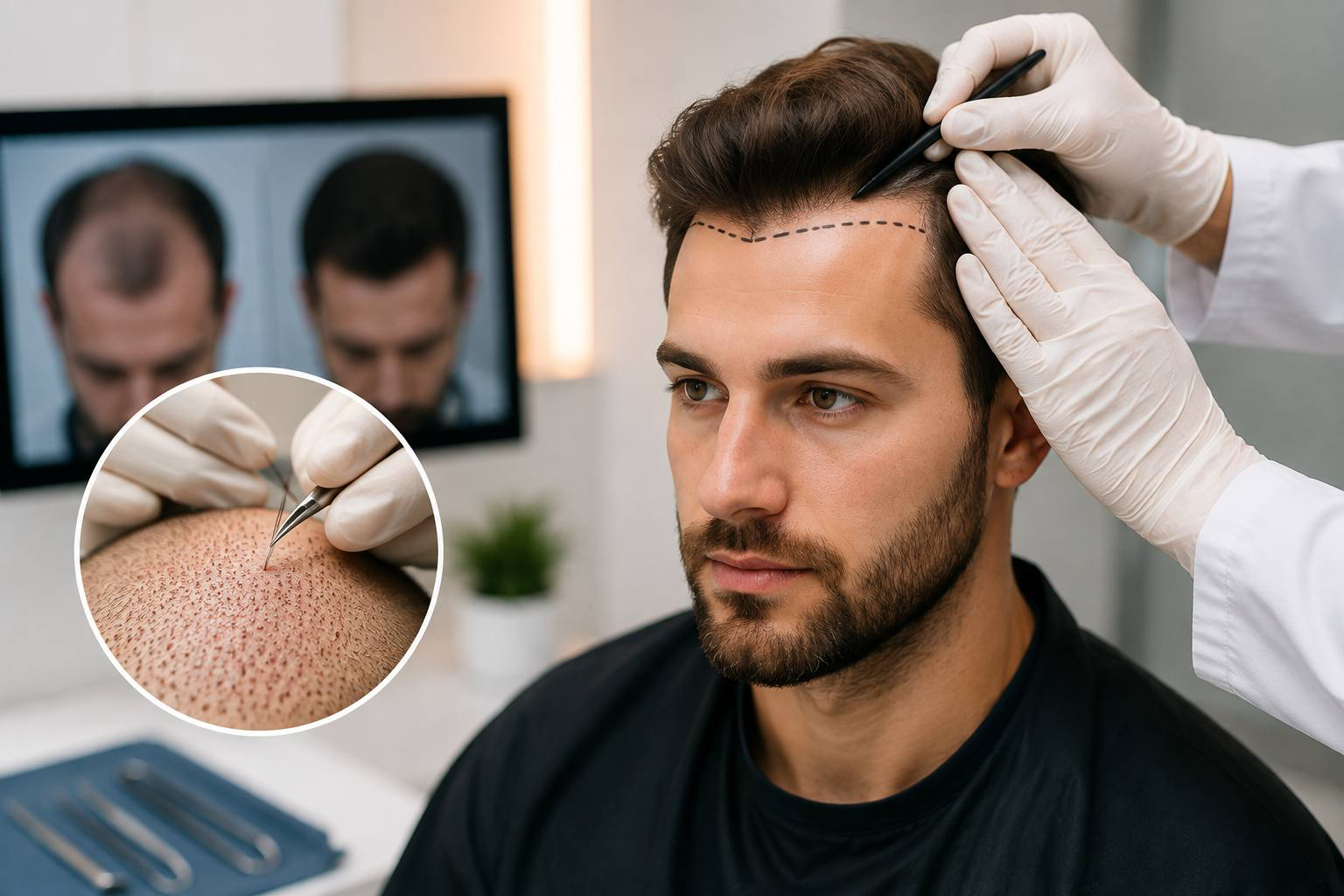
How a hair transplant for women differs from the male procedure, who is a good candidate, and what recovery looks like in Turkey.
How adjustable sutures work in adult strabismus surgery, and what to expect from double vision, redness and alignment in the first weeks.